
Steel line
A steel works of the converter age was a chain of hot handling: iron brought liquid from the furnace, turned to steel in minutes or hours, poured into a ladle, cast into ingots and rolled before the heat had gone. How to run the game's converter is in the Bessemer guide. The vessels themselves are on their own pages: the Bessemer converter and the open hearth. This page follows the metal from pig to ingot, as the works ran it, and then says what the game keeps. The steel line belongs to the planned steel mod and is mostly unbuilt.
Iron arrives
The chain began at the blast furnace. Iron run straight from the furnace, called direct metal, saved melting it a second time; Swedish works had done so since 1857 (Campbell p. 104). Elsewhere it waited on steadier furnaces and on the mixer, an enlarged receiving ladle into which the iron of several furnaces was poured and averaged (Campbell pp. 108-110). A works without direct metal melted its pig in cupolas 6 to 8 ft across, at the cost of some sulphur picked up from the coke (Campbell p. 110). Speed was the point: the iron never stood long enough to cool, and the ladles and vessels were always hot (Campbell p. 110).
The blow
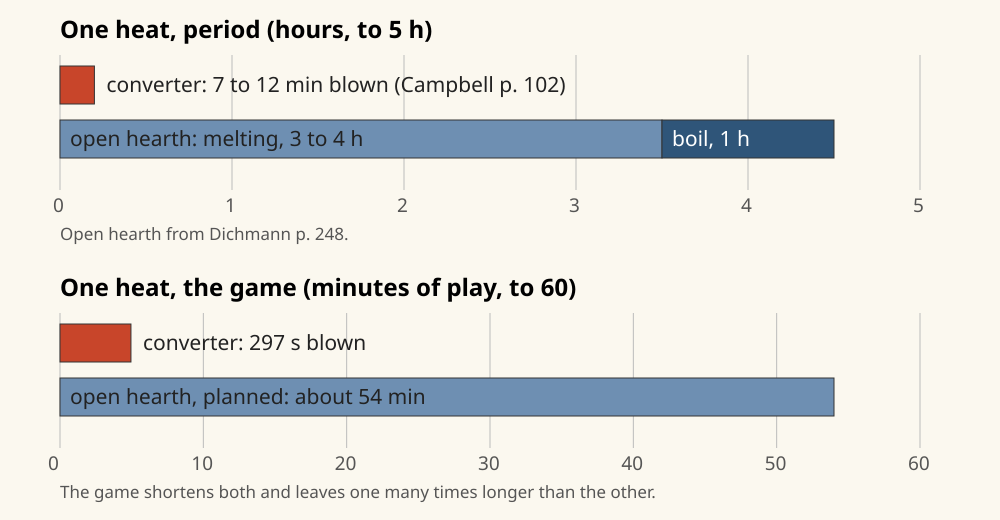
Bessemer's own vessel took 7 cwt of pig, and he described ten quiet minutes, then a growing white flame and a run of "mild explosions", and "in ten minutes more the eruption had ceased, the flame died down, and the process was complete" (Bessemer pp. 143-144). By the 1900s a vessel held 10 to 20 tons in large plants (Campbell p. 100), and a heat was blown in 7 to 12 minutes (Campbell p. 102). The blower read the flame. It brightened as the silicon went, grew to the full carbon flame, and dropped when the carbon was gone (Campbell p. 102). Then the vessel was turned down at once, so the metal lay in the belly below the tuyeres and the blast could stop (Campbell p. 100). A pair of 10-ton vessels made eight heats an hour (Campbell p. 106).
Nothing was added to heat it. The silicon and carbon burning in the blast were the only fuel (Campbell p. 8), and the metal ended hotter than it arrived, from about 1400 C to about 1680 C on Campbell's figures (Campbell pp. 108-109). The cost was iron: about 10% of what went in, 8% at best (Campbell p. 107).
Putting the steel right
A blow does not stop where the steelmaker wants it. It burns the carbon and manganese out (Campbell p. 102), and iron blown without manganese is red-short, which means it breaks up when worked hot (Campbell pp. 8, 22). The cure went in after the blow. Soft steel was blown down to .05% carbon and solid ferromanganese was thrown into the ladle as it filled. Rail steel was stopped at .10% carbon, and liquid spiegeleisen was run into the vessel or the ladle, about one ton of spiegel to ten of steel (Campbell pp. 8, 112). Mushet's patent for the addition dates from 22 September 1856 (Percy p. 814).
Into the ladle, and out by the bottom
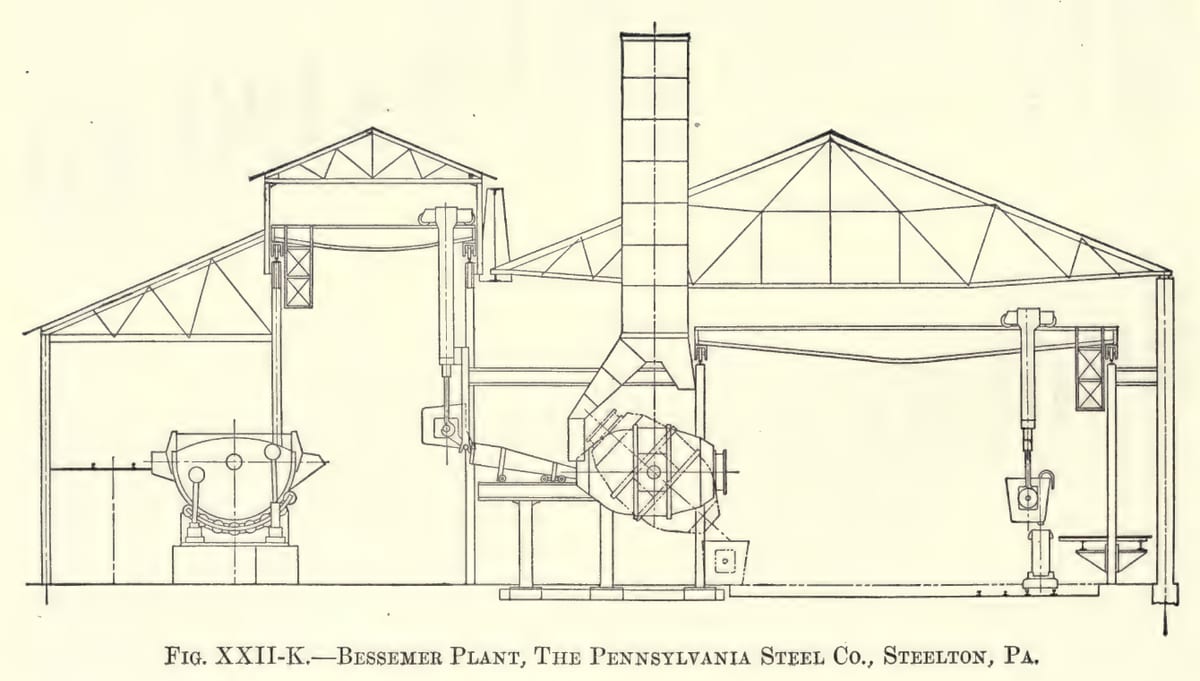
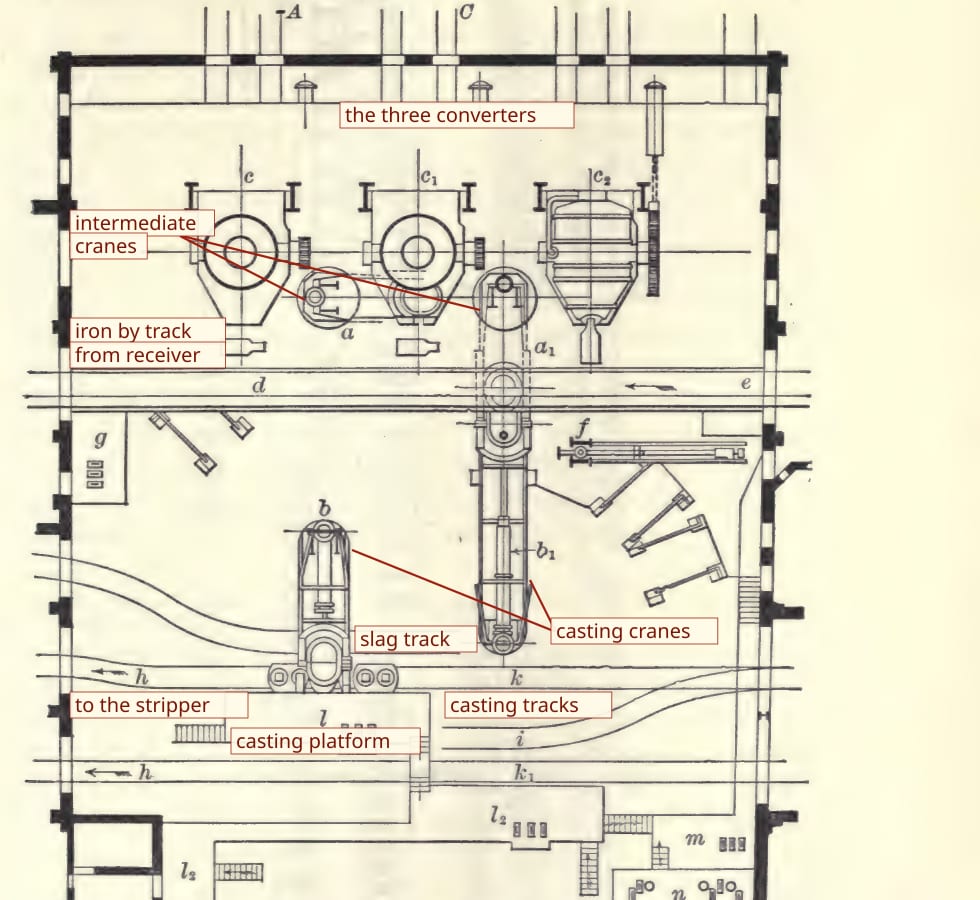
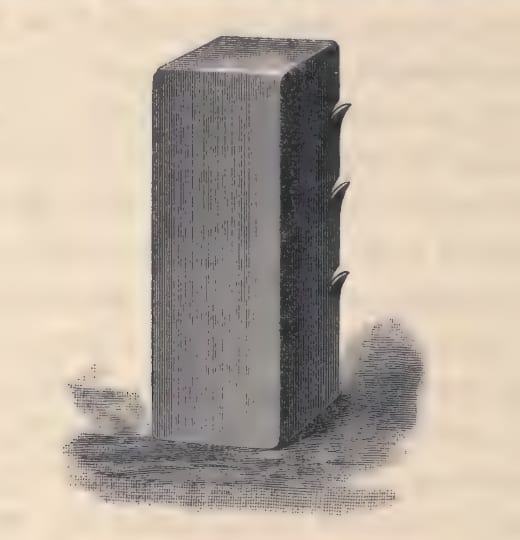
The steel went into a lined ladle and left through a valve in its floor, so that the slag floating on top stayed behind; the separation was perfect (Campbell p. 9). Moulds once stood round a sunk pit under a swinging hydraulic crane (Bessemer pp. 149, 192). Sparrow's Point in Maryland threw out the swinging cranes for a travelling crane and put the moulds on trucks, with a mechanical stripper drawing the moulds off the ingots close to the heating furnaces, and Campbell calls the arrangement universal by his time (Campbell p. 488). After "an interval of eight or ten minutes" Bessemer's first ingot, 10 in square and about 7 cwt, was raised out of its mould standing on end (Bessemer pp. 147, 153).
Stripped, soaked, rolled
An ingot left the mould with a solid skin and a far hotter core. Cooled and reheated from cold, it paid for all its heat again. So it went hot to a pit. In Europe no coal was used to heat ingots for the blooming mill: in the Gjers soaking pit "they heat themselves from internal heat" (Campbell p. 170). In America the unfired pit failed in at least four works, and Campbell's explanation is that acid steel and higher-carbon rail steel do not work well in them (Campbell p. 422). American ingot furnaces resembled the Gjers pit but burned a little gas (Campbell p. 170).
The whole chain had to keep time. In the German works the first round of ingots on a Monday morning stayed twenty minutes in the pits and was fit only for blooms, the next round forty, the next sixty, after which the mill finished rails, billets or beams at one operation for the rest of the week (Campbell p. 543). At Sparrow's Point the piece went from ingot to rail or billet without reheating the bloom (Campbell p. 488). What came off the mill is on rolling a bar.
The other way: the open hearth
The open hearth was the slow route, and took what the converter could not. It exists to use scrap and off-grade pig (Dichmann p. 3). A typical charge in Dichmann is 30% pig and 70% scrap (Dichmann p. 187), the pig below to protect it and the scrap above (H-W p. 56). A good charge melted in three to four hours; the boil rose for about half an hour and faded in about another half hour (Dichmann p. 248). Ore fed by judgement took the carbon down, and calculating the dose was called "absolutely useless" (H-W pp. 59-62).
The melter could look before he committed. A spoon sample, quenched and broken, read the carbon within 2 or 3 points (H-W p. 73), a harder steel was caught coming down on carbon, and one boiled too low was brought back in the ladle (H-W pp. 69-71), so the addition at the end was often unnecessary (Dichmann pp. 239-240). When the boil stopped, the charge was tapped (Dichmann p. 229), through a tap hole opened with a bar; one that froze took 10 to 36 hours of sledging (H-W pp. 71-72). In the United States the open hearth passed the Bessemer in tonnage in 1908 (H-W pp. 12-13), and Campbell names it for railway bridges, boilers and locomotive forgings (Campbell pp. 24-25).
What the game keeps
The game's line is the same chain with fewer stations, and the running order is the part it keeps. Iron from the blast furnace can run straight down a molten canal into the converter, the heat never lost, or go to the casting beds as pig: a choice the player makes with a plate driven into the canal, and the converter wants to stand near the furnace because iron cools on its way. The blow has to be stopped in the carbon band for steel and over-blowing loses metal, recarburising is a required addition, and the open hearth stops on carbon as the period melter did.
Period basis, and what is the game's own
- Period: hot iron went from furnace to converter without being cast, and the ladle and canal replace the transfer ladle and track (Campbell pp. 104, 108-110). The mixer is left out.
- Period: the blown iron is not usable until the addition, by ferromanganese thrown into the ladle for soft steel and melted spiegeleisen at about a tenth of the steel for rail grades (Campbell pp. 8, 112). In the planned game the addition is a step the player cannot skip, and the spiegel comes from a cupola.
- Period: the open hearth is stopped on carbon, so the heat pours without an addition if the player has judged it right (H-W pp. 69-71, Dichmann pp. 239-240). The planned game does the same.
- Period: scrap is the open hearth's food (Dichmann p. 3); the planned hearth is the game's bulk scrap sink and takes coke alongside it where a charge is short of pig (Dichmann pp. 253-254).
- Period: reversal of the checker chambers, by a valve (H-W pp. 39-40). The planned furnace keeps a lever that the player throws.
- The game's own: there are no ingot moulds, no stripper and no soaking pit. Slab, bloom and billet are cast to form in sand in the long flask, a liberty the game takes openly. The real chain from ingot through soaking and cogging ends at the mill.
- The game's own: only carbon is tracked in the blow. Silicon, manganese, sulphur and phosphorus are not counted, and the reagent's strength stands in for the deoxidation. See pig iron.
- The game's own: the heat is much shorter than the period's, and the converter today cannot be finished in survival play, so the line stops short of its first station.
The numbers
Sizes are the game's own, with no scale factor from the period tonnage (see the scaling page); units are in scale and units. "Planned" is the rating in design; values without that word are what the game has now.
| In the game | Period figure | How it was scaled | Game value |
|---|---|---|---|
| Converter charge | 5 tons in small plants, 10 to 20 in large (Campbell p. 100) | The game's own size | 4800 u; planned 6000 u |
| The blow | 7 to 12 minutes (Campbell p. 102); about twenty in Bessemer's first trials (Bessemer pp. 143-144) | The game's own rate; charge size does not change it | 297 s, about 5 minutes |
| Steel from the charge | Loss about 10%, 8% at best (Campbell p. 107) | Period loss, with slag and gas counted | 90% today; planned 85% steel, 12% slag, 3% gas |
| Spiegel addition | About 1 ton to 10 of steel (Campbell p. 8) | The rule at face value | Planned 495 u on a 4950 u heat, about 10% |
| Open hearth heat | Melting 3 to 4 h, boil about 1 h (Dichmann p. 248) | The game's own time | Planned about 54 minutes of process, about 60 minutes tap to tap |
| Open hearth heat size | 60 t the usual size, 15 to 75 t the range (H-W p. 16) | The game's own, four times the converter | Planned 21,600 u of steel |
| Reversal of the chambers | Every 15 to 20 minutes (H-W pp. 14-15) | The game's own time | Planned 300 s at the smallest chambers, longer as they grow |
Picture credits
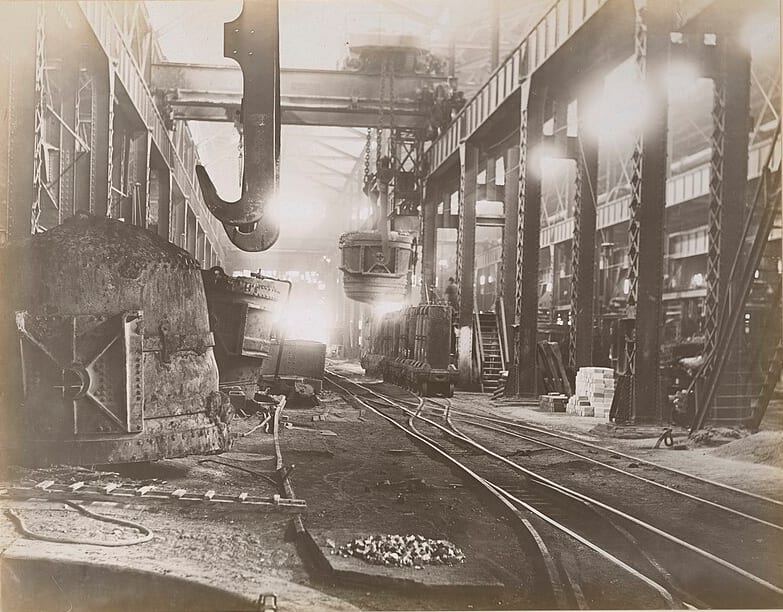
- Filling ingot moulds at the Homestead Works: Carnegie Steel Company, 1917-18, US National Archives, public domain, cropped.
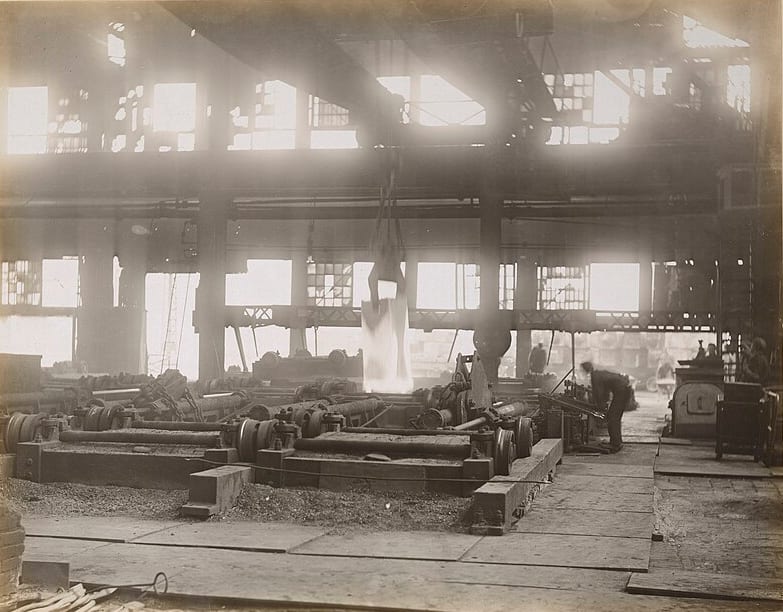
- Ingot being lowered into a soaking pit, Homestead: Carnegie Steel Company, 1917-18, US National Archives, public domain, cropped.
- Fig. XXII-H, labelled for this site, and Fig. XXII-K: Campbell, The Manufacture and Properties of Iron and Steel, pp. 475 and 486, Library page.
- Fig. 48: Bessemer, An Autobiography, p. 154, Library page.
- The times of one heat: drawn for this page from Campbell p. 102 and Dichmann p. 248.
Comment or suggest something in the Expanded thread on the Vintage Story Discord