
Lancashire boiler
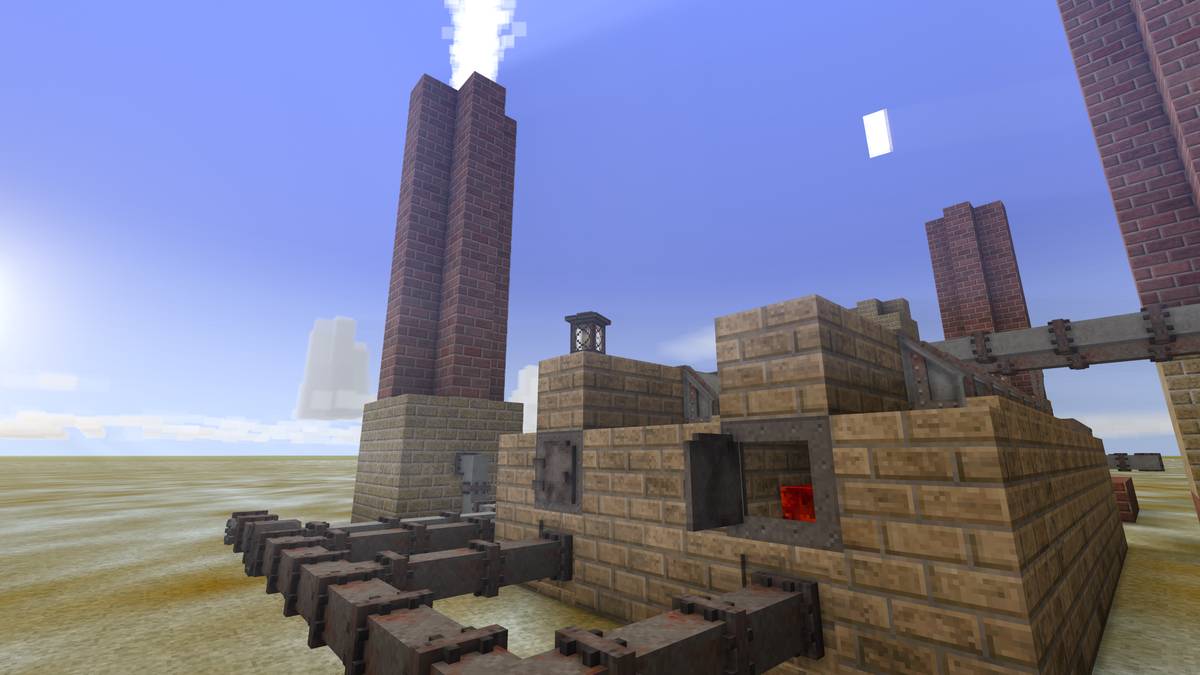
A Lancashire boiler is the Cornish boiler with its single fire tube replaced by two smaller ones, side by side. Fairbairn calls it the ordinary form of the boiler in the manufacturing districts (Fairbairn Useful pp. 300-301), and it is the game's higher-pressure boiler. Its parts are in the catalogue, and steam itself is taught in the steam and boilers guide. This page is about the real one and how the game's follows it.
Why two tubes
A boiler with one tube has a single flue carrying all its fire. That flue has two troubles. Hawkins gives the Lancashire as the remedy for the first, and for poor combustion (Hawkins p. 55); the second is the reason a smaller tube is worth having.
The first is movement. The fire tube is the hottest part of a boiler, so it grows lengthways more than the shell, bulges out the ends, and shrinks back when the fire is out, working loose where it is riveted. Even in steady use its temperature swings with each charge of coal, and Hawkins says this working weakens the tube until it "frequently collapses" (Hawkins p. 55).
The second is strength against collapse, which was measured only late. A fire tube is pressed on from outside, and it had been assumed that a cylinder under outside pressure was stronger than the shell under inside pressure (Fairbairn Useful p. 300). Fairbairn's experiments showed the opposite. An ordinary mill Lancashire of about 30 ft by 7 ft, in 3/8 in plate throughout, had a shell good for about 303 lb per square inch and flues that would give way at about 100 lb, a third of it (Fairbairn Useful p. 301). Tubes alike in other respects were found to vary in strength inversely as their length and as their diameter (Fairbairn Useful pp. 301-303): two real boiler flues 42 in across and 3/8 in thick failed at 97 lb when 35 ft long and at 127 lb when 25 ft long (Fairbairn Useful p. 303).
No book at hand states the argument outright, but it follows from that rule. Wilson weighs the same duty both ways: for a grate of about 20 sq ft, a Lancashire of 7 ft with two tubes of 2 ft 9 in in place of a Cornish of 6 ft with one tube of 3 ft 6 in (Wilson pp. 300-301). By Fairbairn's rule a 33 in tube is about 1.27 times as strong as a 42 in one of the same length and plate, and the grate is divided between two of them.
The price is room. Two furnaces have to fit inside the shell below the water, which is why the shell should not be under 7 ft (Hawkins p. 58), and low furnaces burn badly: the cold crown plates quench the flame, and there is no room above the fuel for the air the gases need (Hawkins pp. 55, 57).
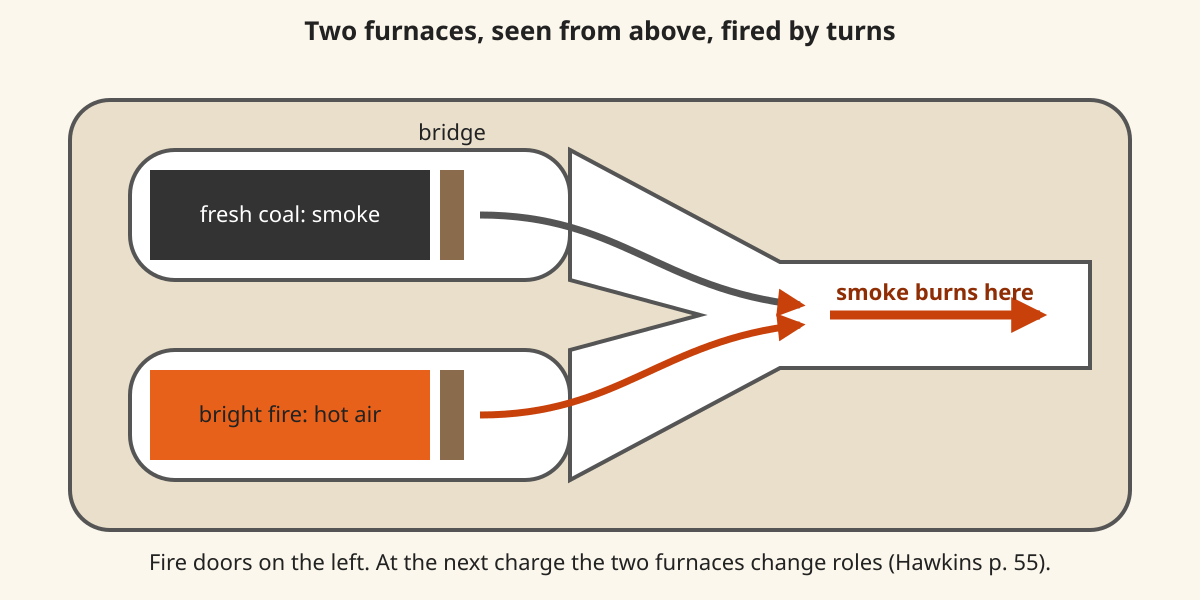
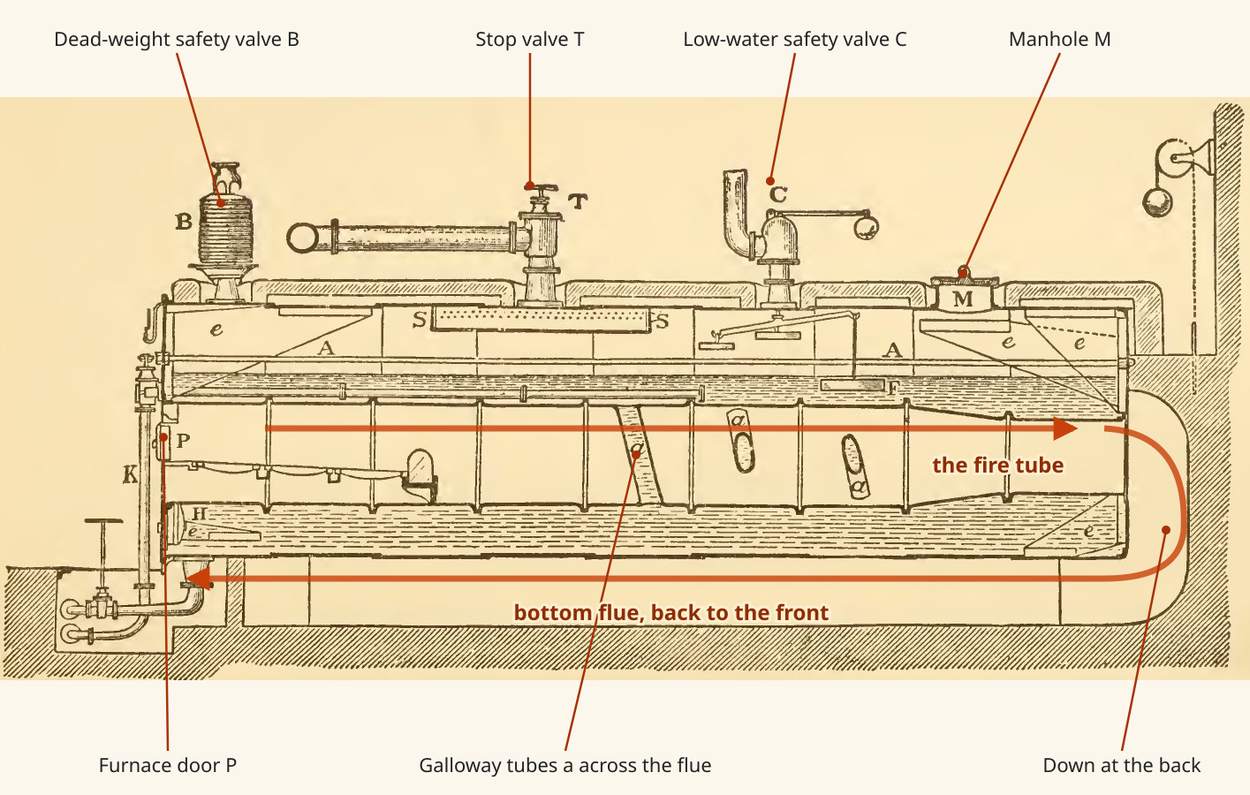
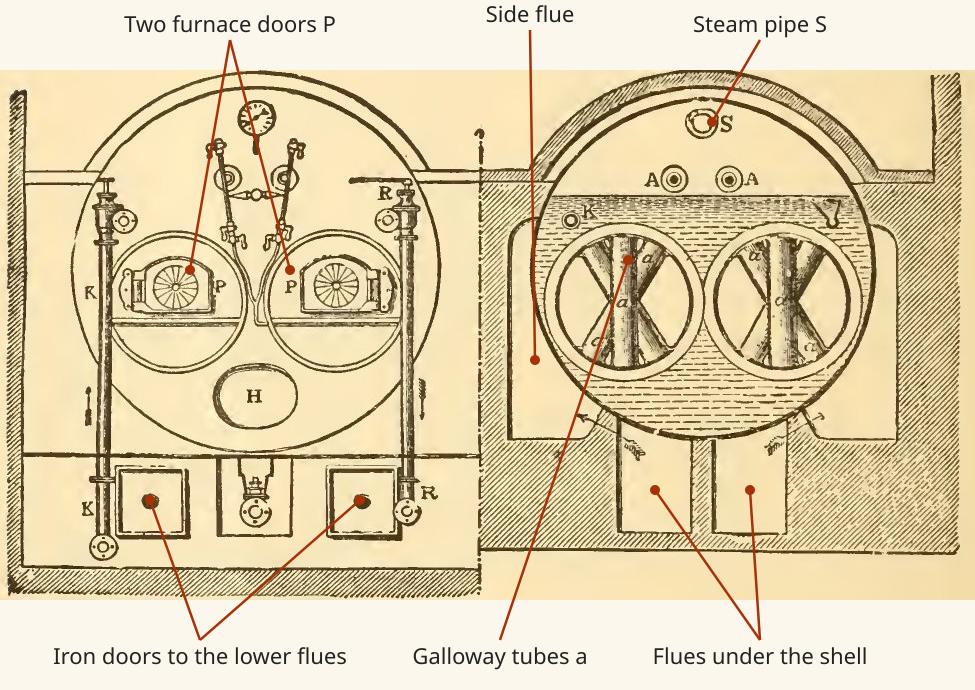
The double furnace with alternate firing is credited to Fairbairn (Rankine p. 282). Hawkins says the tubes usually joined into one flue, though his cuts draw them separate to the back (Hawkins p. 55). Rankine knows both forms and gives the fault of the straight pair: the two streams do not mix until they have cooled, and some boilers were given transverse tubes near the bridges to mix them (Rankine p. 473). This only works if the firemen keep to it, "if the firing is properly conducted" (Hawkins p. 55).
The Galloway tubes
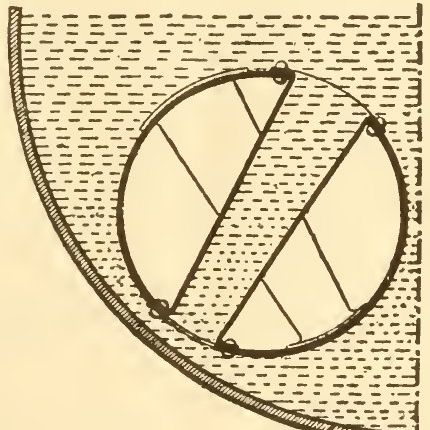
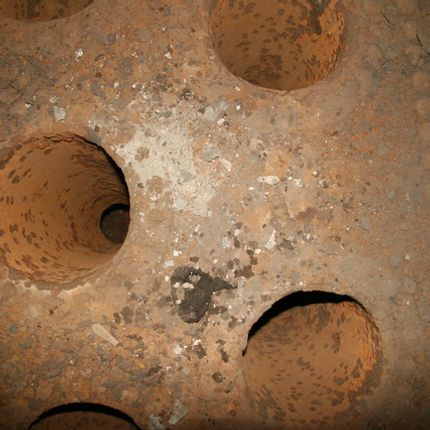
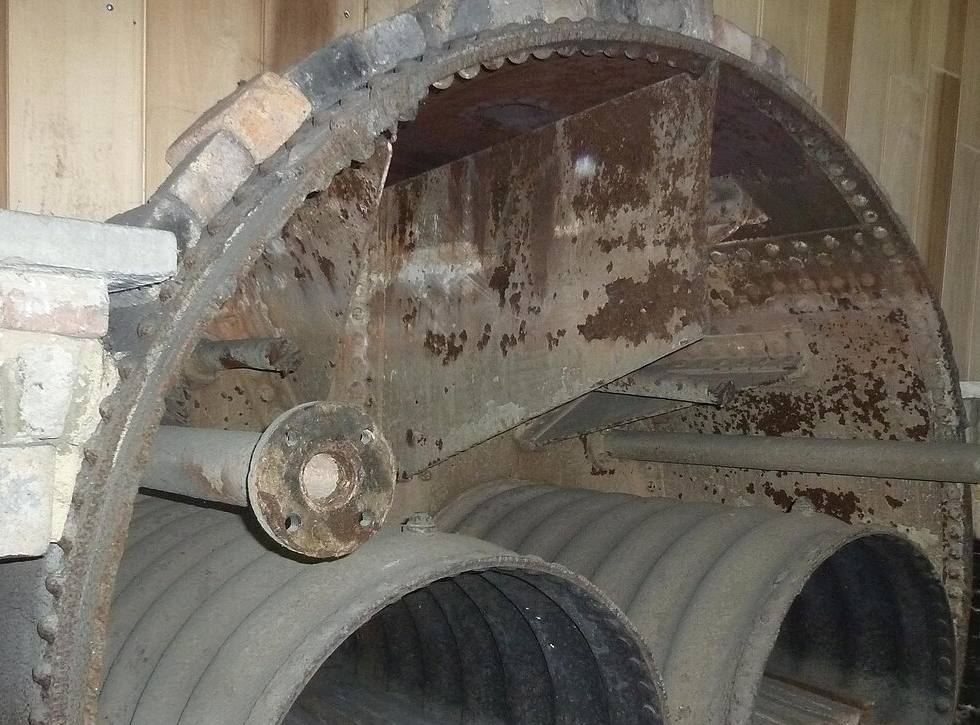
Conical tubes, flanged at each end and riveted across the flue, stand open to the water on both sides. They stiffen the flue, add heating surface and promote circulation (Hawkins pp. 57-58). The surface they add is small: 30 sq ft of 850 on Hawkins's boiler (Hawkins p. 60), so what they give is mostly the stiffening and the stirring. The Wigan trials of 1868 found Galloway boilers no better on the coal than the plain Lancashire (Wilson p. 294), while Hawkins says the Galloway or Lancashire boiler is considered the most economical used in England (Hawkins p. 59); he does not separate the two.
What the outside flues still do
The gas leaves the tubes still hot, so the brick setting goes on taking heat from it, as on the Cornish. On Hawkins's boiler the two internal flues and furnaces give 450 sq ft, the Galloway tubes 30, and the outside flues 370 (Hawkins p. 60): 43% of the plate exists only because of the brick around it. The Wigan trials ran a Lancashire with its outside flues cut out and lost only a little economy (Wilson p. 293); the flues pay most on a boiler driven hard (Wilson p. 294).
On the order of the flues, Hawkins takes the gas under the bottom first and only then along the sides, which keeps the bottom hotter and promotes circulation so the coldest water does not lie at the bottom (Hawkins p. 59). That is the reverse of what he gives for the Cornish (Hawkins p. 54); Rankine allows either a wheel-draught or a split-draught on double-furnace boilers (Rankine p. 473).
Period basis, and what is the game's own
- Period: two internal furnace tubes in one shell, the gas back through the tubes, forward along the bottom and back by the sides (Hawkins p. 59); usual length 27 ft, shell not under 7 ft, furnaces at least 33 in (Hawkins p. 58). The game plans to draw this: a shell of about 8 ft, two tubes of at least 33 in, about 27 ft long, and two fire doors.
- Period: two fire doors fired by turns (Hawkins p. 55). The game plans two doors; it does not model alternate firing.
- Period: the collapse of the fire tube was the danger the boiler's form responded to (Fairbairn Useful p. 301). The game's boiler fails by bursting when held at its pressure ceiling; its tubes do not collapse.
- The game's own: the boiler today burns a coal pile laid beside it, whatever the coal, with no bed inside the shape. The Cornish has one; this boiler is the exception until the vessel gets a bed.
- The game's own: its stat table is game balance rather than scaled from a book. It sets the higher pressure band of steam, above the Cornish.
- The game's own: the base game's boiler is a liquid container heated by a firepit that feeds a condenser, with no steam and no pressure. See vanilla against reality.
The numbers
Boilers keep period figures rather than the fuel factor of the iron furnaces (see the scaling page), drawn at true size (scale and units). The Lancashire's figures are the exception: most below are the game's own.
| In the game | Period figure | How it was scaled | Game value |
|---|---|---|---|
| Shell | 27 ft by 7 ft usual (Hawkins pp. 58, 60); about 30 ft by 7 ft in the mills of 1860 (Fairbairn Useful p. 301) | Planned at true size | Six blocks long, smaller than the Cornish; planned about 27 ft by about 8 ft |
| Furnace tubes | Two, at least 33 in (Hawkins p. 58) | Planned at true size | Flues drawn, one vessel inside; planned two tubes of at least 33 in |
| Heating surface | 850 sq ft on the worked boiler (Hawkins p. 60) | Not used | Not modelled |
| Grate | 33 sq ft (Hawkins p. 60) | Not used | Coal pile beside the boiler |
| Working pressure | 75 lb a sq in, 5.1 atm (Hawkins p. 60) | Game's own, higher than the period | Chokes at 12.0 atm, so about 176 lb |
| Steam space | About 240 cu ft in a 7 ft by 30 ft boiler, 6.8 m3 (Wilson p. 148) | Game's own | 1,200 L for the whole vessel, water and steam together |
| Water boiled | 1 cu ft an hour from 16 sq ft (Wilson p. 300), about 53 cu ft an hour or 1,500 L/h at 850 sq ft | Game's own | 3 L/s, 10,800 L/h, about seven times the period rate |
| Steam out | None given in these terms | The game's own | 48 L/s |
| Burst | None given | The game's own | 30 s held at 12 atm; blast radius 4 blocks |
Open, and what you can tell us
The books at hand do not date the first Lancashire boiler or the first Galloway tube. Rankine names Fairbairn for the double furnace (Rankine p. 282), and Hawkins treats the form as settled. The Wigan result and Hawkins's praise of the Galloway boiler also pull against each other: if you have trials that compare the plain boiler and the Galloway on the same coal, we would like to read them.
Picture credits
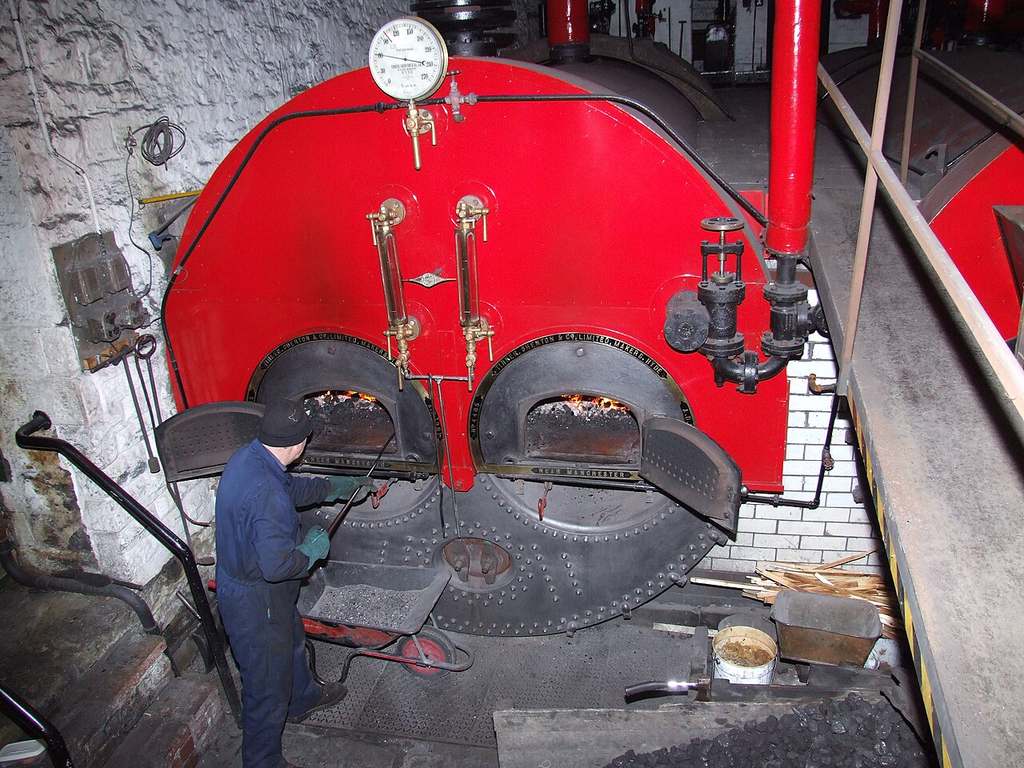
- Queen Street Mill, Lancashire boilers, stoking: Clem Rutter, Rochester, Kent, CC BY 3.0.
- Lancashire boiler furnaces, sectioned, Crofton: Andy Dingley, CC BY-SA 3.0, cropped.
- Inside a Galloway boiler, Papplewick Pumping Station: Chris Allen, CC BY-SA 2.0, cropped.
- Figs. 18, 19 and 20, labelled for this site, and the Galloway tube cut: Hawkins, Maxims and Instructions for the Boiler Room, pp. 56, 58 and 57, Library page.
- Alternate firing: drawn for this site from Hawkins p. 55.
- The game's boiler: a screenshot of the mod in a test world.
Comment or suggest something in the Expanded thread on the Vintage Story Discord