
Cowper stove
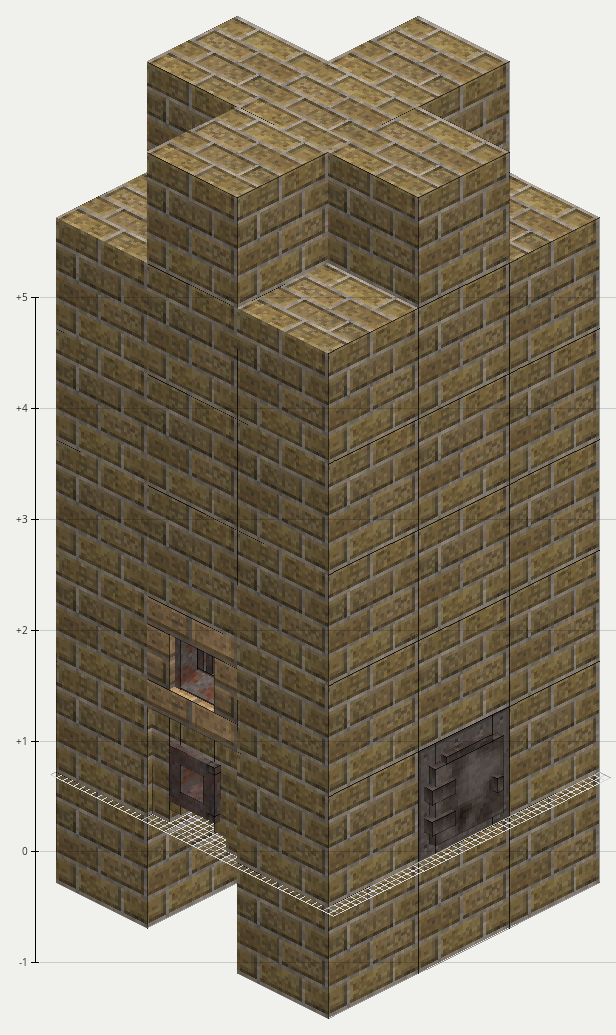
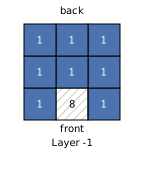
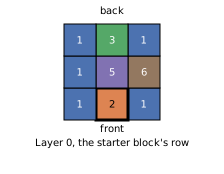
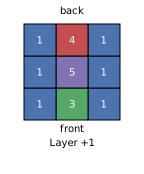
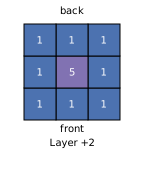 Layers +2 to +3 (the same course)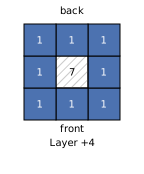
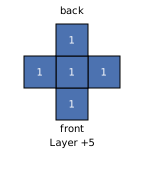
| # | Colour | Name | Matches |
|---|---|---|---|
| 1 | any Refractory bricks | game:refractorybricks-good-tier* | |
| 2 | Cowper Stove Intake | siex:cowperstove-intake-*-* | |
| 3 | Pipe Outlet | iiex:pipe-outlet* | |
| 4 | Cast Pipe Passthrough (Straight) | iiex:pipe-cast-passthrough-* | |
| 5 | Heat Sink | siex:cowperstoveheatsink-* | |
| 6 | Iron hatch door | game:cokeovendoor-*-west | |
| 7 | Empty (air) | game:air | |
| 8 | Empty (air, or a pile of coal) | @(air|coalpile) |
Materials
| Block | Cells |
|---|---|
| any Refractory bricks | 48 |
| Cowper Stove Intake | 1 |
| Pipe Outlet | 2 |
| Cast Pipe Passthrough (Straight) | 1 |
| Heat Sink | 4 |
| Iron hatch door | 1 |
Facings and connectors
- Iron hatch door turns with the structure; segment 3 of its code names the face.
What it is
A cowper stove is the regenerator of the hot-blast plant: a brick shell three blocks square and seven courses tall, with a stack of four Heat Sink blocks up its middle and four pipe connections. It stores the furnace's waste heat and gives it back to the blast. A Cowper Stove Intake at the foot of its front face starts it and sets the frame the rest is built into. Hot blast explains how it runs and how a pair of stoves is worked.
Build order
- Clear a space three wide, three deep and seven tall, and leave the cell directly under the intake free as well: that is where the coal pile goes.
- Place the intake at the bottom of the front face, turned so it faces out of the stove. Its facing sets the frame for the rest.
- Ctrl plus shift and right-click the intake to project the build outline and build into it.
- Lay the brick foundation course under the shell, then the shell itself. Refractory brick of any tier will do; the tier only changes how the intake looks.
- Stack the four Heat Sink blocks in the middle column, starting level with the intake. They are the regenerator: a stove built without them is just a chimney.
- Set the iron hatch door in the side wall at intake level, the two pipe outlets and the pipe passthrough where the outline puts them, and leave the air cell near the top clear.
- Cap the top course.
Orientation
The intake takes exhaust on its outward face, the one the pipe main should meet. The rest of the stove sits behind it.
The four pipe connections are fixed by the layout, not by the player: bottom pair for exhaust, upper pair for air. The bottom outlet is on the far side at intake level, the passthrough directly above that, and the hot blast leaves through the outlet directly above the intake.
The iron hatch door turns with the structure, so its facing is whatever the outline shows rather than a fixed compass direction.
First run
- Valve each of the four lines. Two valves per stove is the working arrangement, one on the exhaust side and one on the air side.
- Pipe the furnace's exhaust outlet to the intake, the stove's bottom outlet onward to the next stove or to the smoke stack, the air main to the passthrough, and the upper outlet to the furnace tuyeres.
- Light the furnace first. A stove has no heat of its own and nothing happens before exhaust flows.
- Open only the exhaust line. Look at a heat sink: its temperature is the charge, and it climbs to a ceiling of 1240 C.
- Put a burning coal pile in the cell under the intake to charge several times faster, and let it burn out before the stove is put on blast.
- When the stove is hot, shut the exhaust line and open the air line. Air leaves at the core temperature.
What goes wrong
"Cannot heat up, exhaust mixes with the air!" Both lines are open at once. Shut one. The stove vents the air stranded in the passthrough when the air valve closes, so the message clears in a second or two.
It will not take air after a swap. Air left in the line blocks it: the stove cannot push into a side already at higher pressure. Vent the line rather than working the valves faster.
It sits cold and does nothing. With no flow on either line a stove neither heats nor cools. That is normal.
It heats very slowly. There is no coal pile under the intake, or the pile has gone out. Without one the charge rate is a fifth of anthracite's.
It will not craft. The intake and the heat sinks both need a straight cast pipe, which has no recipe.