
Cold blast furnace
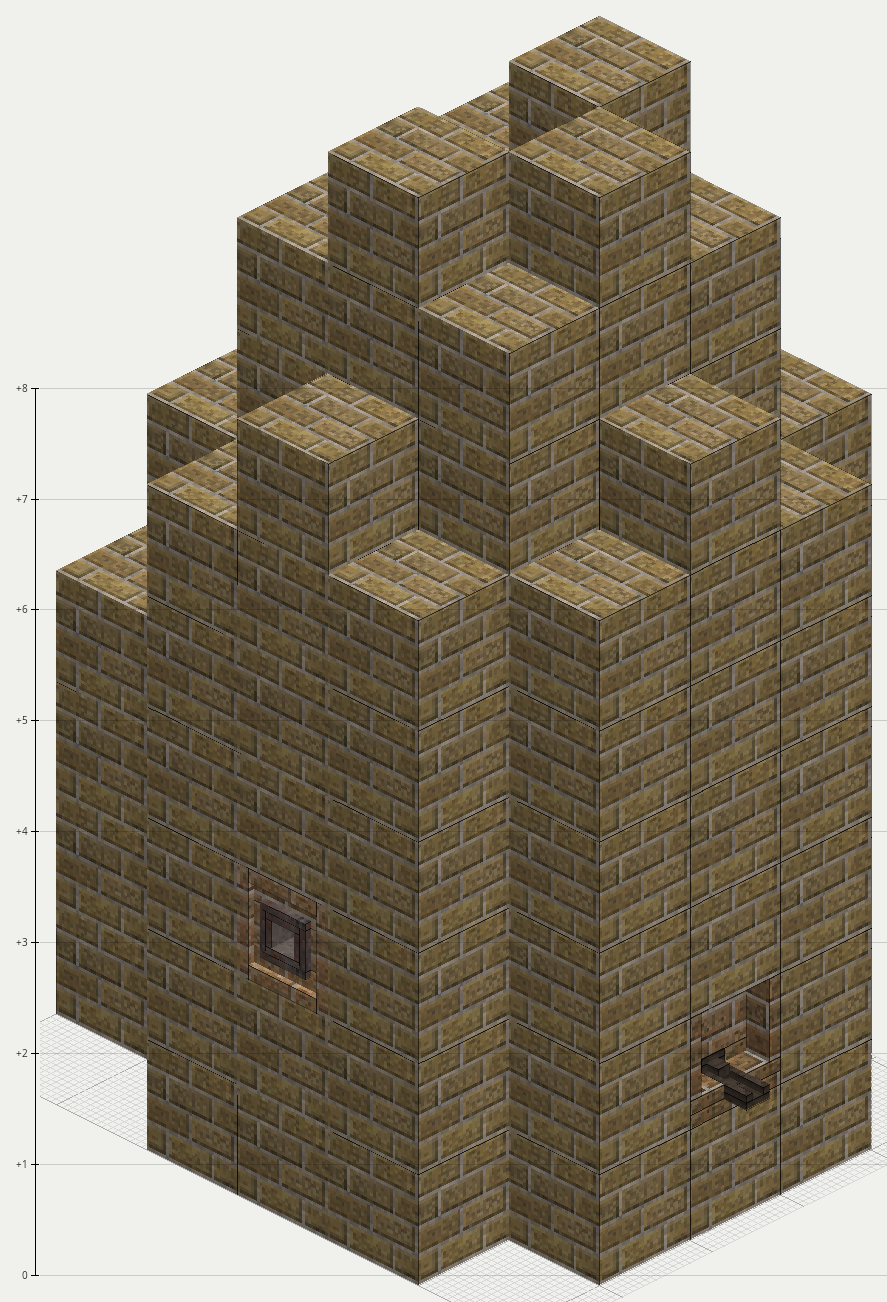
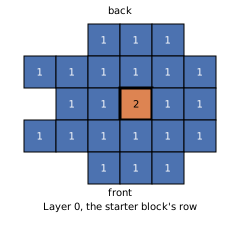
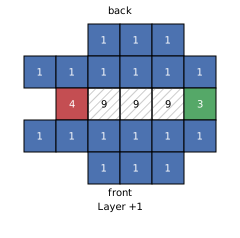
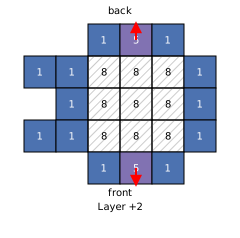
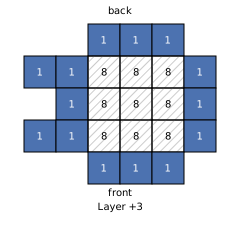
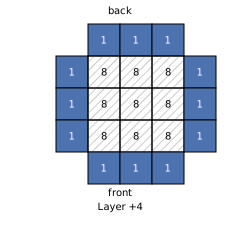 Layers +4 to +5 (the same course)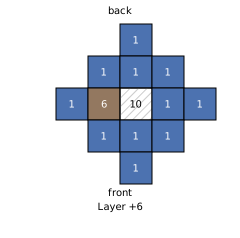
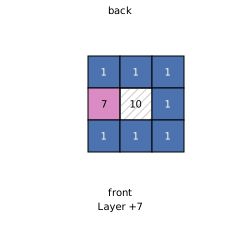
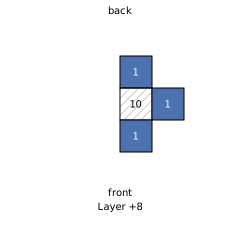
| # | Colour | Name | Matches |
|---|---|---|---|
| 1 | any Refractory bricks | game:refractorybricks-good-tier* | |
| 2 | Cold Blast Furnace Core | iiex:furnace-blastcore-*-n | |
| 3 | Iron Tap | iiex:furnace-irontap-w | |
| 4 | Slag Tap | iiex:furnace-slagtap-e | |
| 5 | Tuyere | iiex:furnace-tuyere-* | |
| 6 | Tall Hopper | iiex:hopper-tall-e | |
| 7 | Reserved space (kept clear) | exlib:structurefiller | |
| 8 | Empty (air, or a pile of coal, or a charge Pile) | *:@(air|coalpile|furnace-chargepile) | |
| 9 | Empty (air, or a pile of coal, or a charge Pile, or a solidified Metal) | *:@(air|coalpile|furnace-chargepile|hearthmetal-.*) | |
| 10 | Empty (air) | game:air |
Materials
| Block | Cells |
|---|---|
| any Refractory bricks | 111 |
| Cold Blast Furnace Core | 1 |
| Iron Tap | 1 |
| Slag Tap | 1 |
| Tuyere | 2 |
| Tall Hopper | 1 |
Facings and connectors
- Cold Blast Furnace Core turns with the structure; segment 4 of its code names the face.
- Iron Tap turns with the structure; segment 3 of its code names the face.
- Slag Tap turns with the structure; segment 3 of its code names the face.
- Tall Hopper turns with the structure; segment 3 of its code names the face.
- Connectors on the north face: cell 0,2,-2.
- Connectors on the south face: cell 0,2,2.
What it does
The cold blast furnace is the iron tier's primary smelter: a tall open-topped stack of refractory brick that reduces ore burden to molten pig iron and slag. It smelts ore and only ore. Scrap goes to the Cupola furnace.
Building it
- Place the core first. It is the hearth grate at the bottom centre of the stack, and the whole build hangs off it.
- Ctrl plus shift plus right-click it to raise the build outline and its shopping list. The outline appears on the core, the taps, the tuyeres and the hopper alike.
- Lay the walls course by course, leaving the shaft hollow. The hollow is where the charge goes.
- Set the two tuyeres facing each other across the shaft, two courses above the base.
- Set the iron tap and the slag tap at opposite ends of the hearth course, one course above the base. Both sit at the same course; the iron notch is drawn at the crucible floor and the slag notch higher in the same wall, so the difference is in the art, not the height.
- Set the tall hopper over the shaft mouth. It is two blocks tall.
- Keep laying until the outline reports the structure complete.
The core's side variant fixes the facing and the whole layout turns with it, so build from a core already facing the way the furnace should face. Each part is its own blocktype: an iron tap in a slag tap's cell leaves the structure incomplete rather than working the wrong way round.
There is no door. The open top of the stack is its chimney, and the furnace vents straight up and recycles nothing, which is exactly what makes it the cold blast furnace. A finished furnace is cleared by breaking its walls.
Refractory bricks of any tier are accepted, and the core wears the tier it was crafted from.
The charge
The shaft is charged in rounds through the hopper, fuel under burden, one material per load. Ignition waits for a complete bottom course across every column, not for a quantity, and the hopper's own lowest-column-first rule produces that if the rounds are laid whole.
How much fuel goes in is the one dial the furnace has. A rich charge blows easily, runs hot and eats coke; a lean one packs dense, demands more pressure than this tier can raise, and stalls below iron's melting point. On cold blast the break-even is just under 24 per cent carbon, so charge generously. See Ore handling and burden and Furnaces and heat.
Blowing it
Both tuyeres are pipe ports. Run Plated Piping (Straight) from a Twin-Tub Blower to them and keep them on one network, so the pressure the blower raises is shared. Cap every other opening: an open pipe end clamps the whole run to 1 atm.
The furnace's block info states the pressure the burden in it demands and the air it is drawing, against what is arriving. The pressure is a threshold, not a target: a tuyere on a line below the demanded pressure draws no air at all and the furnace reads zero supply, while a line at or above it draws in full. See Furnaces and heat.
The first run
- Put a canal start under each tap's spout, or accept that the metal sets at the tap.
- Charge the shaft in rounds until it is full.
- Start the blower and let the line come up to pressure.
- Break the plug out of a tap with an empty hand, then hold a torch to the open tap to blow the furnace in.
- Watch the block info. Firing means it is burning; Melting means it is rendering iron.
- Stop the tap again with fire clay when the run is done, or leave it open and let the canal carry the heat away.
What goes wrong
It lights and never gets hot. The charge is too lean, or the blast is short. Both sides of the ledger are on the block info, so the answer is readable rather than guessable.
It says Firing and makes nothing. The burden at the raceway is below its melting point and has stopped its column. Everything above rests on it and no fresh carbon comes down, so the furnace goes out within minutes. Break the charge blocks out of the shaft to recover the charge.
It will not light at all. No carbon is standing at a raceway; the bottom course has to be carbon across every column. The blast has nothing to do with lighting, and a charged shaft lights from a torch with the blowers stopped.
It went out on its own. A shaft furnace reads Idle on the tick no carbon stands at a raceway, and going out burns its residue, which takes the carbon at every raceway with it. Charge the shaft again and light it again through a tap.
A wall was knocked out and it will not re-light. A breached furnace burns on at natural draught and can never be re-ignited. Complete the structure first.
The pool stopped filling. It is full. The iron and slag pools are capped separately and either one of them full stops the melt, so flush the slag as well.