
Coke and fuel
as of 0.8.0
Every furnace in the mod burns solid fuel, and two different rules decide what it will take. A shaft furnace charges fuel into its column and prices it by carbon. A reverberatory furnace loads a fuel bed in its Firebox and prices it by burn temperature. Coke clears both, which is why the whole tier is built around it.
Carbon: what a shaft furnace burns
A shaft furnace meters production by the carbon it burns in front of its tuyeres, so a fuel is worth
what its carbon is worth. Fuel carbon comes from the fuel material role in
assets/iiex/config/materialroles.json, divided by the reference value of 2.
| Fuel | Role value | Carbon per unit |
|---|---|---|
game:coke | 2 | 1.0 |
game:charcoal | 1 | 0.5 |
| any other fuel granted the role with no value | 1, the fallback | 0.5 |
A grant with no value therefore carries charcoal's carbon rather than coke's. Charcoal is a legitimate fuel, and a charcoal course runs cooler and shorter than a coke course of the same height, because it carries half the carbon. Raw coal is not a shaft fuel at all: it is not in the role table, so the furnace does not recognise it.
Burn temperature: what a firebox takes
A Firebox burns plain fuel and asks mainly that it burns hot enough. Anything whose
combustibleProps declare a burn temperature of 1000 C or more is admitted, which lets coke,
charcoal, anthracite and the harder coals in and keeps firewood, peat and the rest out.
The machine that owns the bed can narrow that. The Puddling furnace, the Heating furnace and the Crucible furnace all refuse lignite by name, as too low-rank to carry a metallurgical heat: it burns at 1100 C and so clears the floor, which is why it has to be refused by name rather than by temperature. The Cornish Boiler keeps the plain rule and takes lignite, since raising steam is not metal work. The Coke oven narrows it the other way and takes only the coals that coke.
A bed holds one fuel at a time. It is drawn as 6 layers of 2 units per firebox cell, so one cell holds 12 units, and a furnace's bed is 12 units per firebox cell it declares. The puddling furnace has one firebox cell and its fire-hole fireplace, which holds 9, so 21 units; the two share one burn of 1.2 units an hour. The reheating furnace has two cells, so it costs twice as much for the same visible fill and burns each at 1.2 units an hour, though the player charges it with one click. Clicking the bed with fuel in hand spreads one deposit across every firebox cell of the owning furnace.
A lit firebox burns its beds down at a steady rate whatever the heat: every bed spends 1.2 units a
game hour (FireboxBurnUnitsPerHour), so a full bed lasts 10 game hours and its courses drop one by
one. The furnace stays lit while any bed holds fuel and goes out when they are all empty. Charging
a course into a lit bed tops it up and lengthens the burn. A bed that has gone out is lit by hand again, and a furnace that is still warm starts from the heat it has left, never under 900 C.
The Coke Oven
Coal is not fuel here; coke is, and coke is baked from coal. Vanilla's sealed coal pile does this one pile at a time. The Coke Oven Core anchors a one-chamber beehive oven that does it at the scale an ironworks needs: nine cells of coal in its chamber, as much as 18 vanilla coal piles.
| Quantity | Value |
|---|---|
| bake time, per chamber | 12 game hours (24 real minutes at the default day; sleeping passes it) |
| warm-up before the clock starts | 2.5 game hours |
| coal that survives as coke | 0.75 of the charge, truncated |
| cells per chamber | 9, at 32 units each, 288 in all |
| coal that cokes | bituminous only |
| light temperature | 400 C |
A full chamber of 288 coal gives 216 coke, the same rate as vanilla's coal pile. The gain is the size of the charge, not a better rate. Anthracite has no coking rate in vanilla and does not coke here either, and lignite is refused. The accepted list lives in config, so a modded coal can be admitted without a patch.
Coal goes in through the Top Hopper in the oven's roof, under the lid. It cannot be put in by hand.
Coking is destructive distillation: the coal has to be heated out of contact with air. A chamber is sealed only when both its closures are shut, the Charge Lid in the crown above it and the Coke Oven Door at its front. A chamber standing open bakes nothing, however long it is left. Opening a lid mid-bake pauses that chamber and shutting it again carries on from where it stopped; the clock is not reset.
The chamber keeps its own clock; coke while one oven bakes takes a second oven.
The drawing door
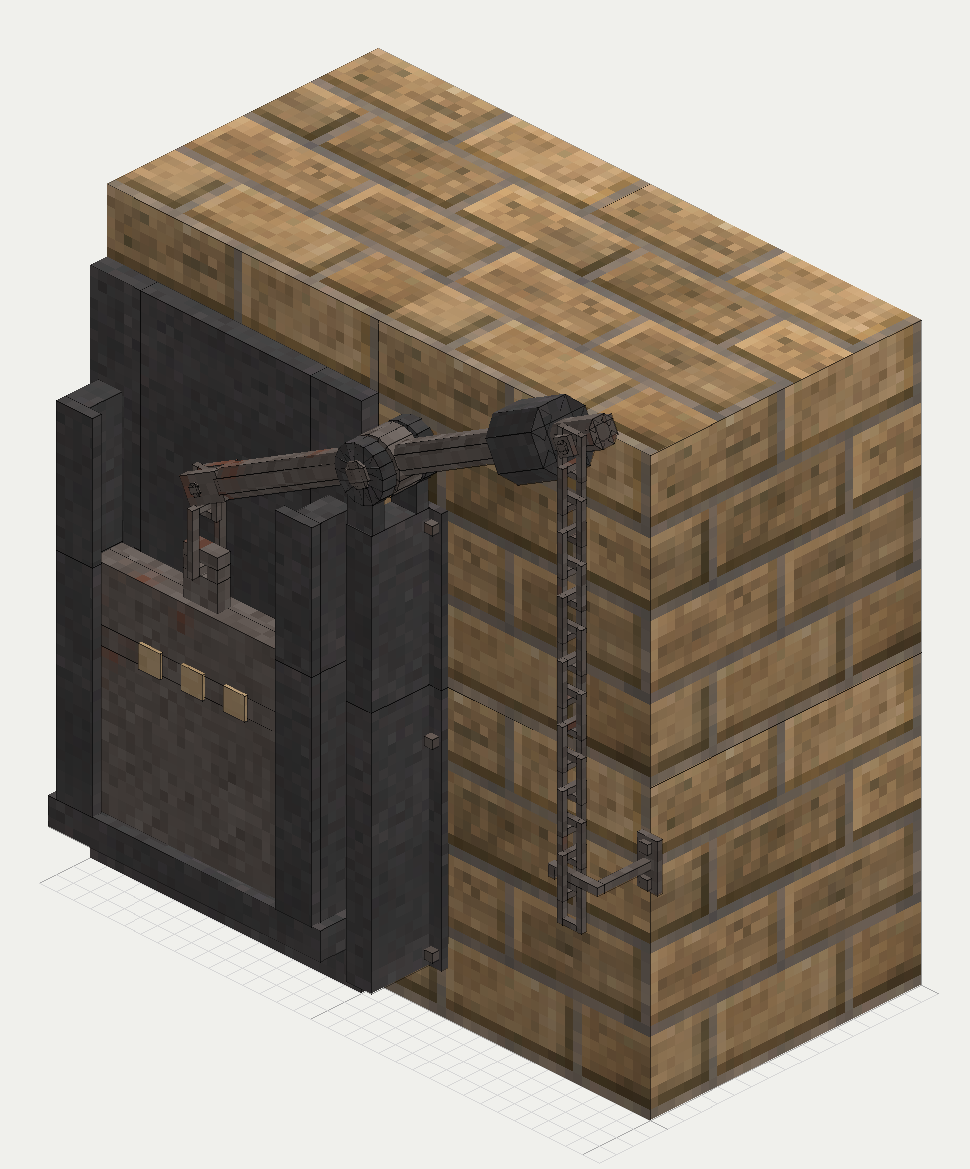
The Coke Oven Door is a wrought-iron door filled with fire brick, sliding between the two ribs of a cast-iron frame. A lever on a post beside it balances the door, and a chain runs from the lever's tip to an eye on the door, and a hand chain holds it to a hook in the wall. A right-click on the door or on the lever post works it. Open, it leaves its opening clear, so the coke can be dug out through it; shut, it closes the opening. See Coke Oven Door.

Step by step
- Build the oven up from its Coke Oven Core.
- Open the Charge Lid on the roof and pour bituminous coal into the Top Hopper under it until the chamber holds 288. The hopper holds 128 at a time and empties itself into the chamber.
- Shut the lid and the Coke Oven Door.
- Hold a flame to the lower half of the door: a lit torch with shift and right-click, or a firestarter with right-click.
- Wait 14.5 game hours, 2.5 to heat up and 12 to bake.
- Open the door and dig the coke out with a shovel, 2 coke to a dig.
What goes wrong
The flame will not take. The chamber is not completely full, or the oven is not finished. It needs all 288 coal, and the outline has to read complete.
The chamber never progresses. It is not sealed. Both the lid above it and the door in front of it must be shut.
The hopper refuses the coal. Only bituminous coal cokes. Charcoal and coke are not coal, anthracite will not coke, and lignite is refused.
The blast furnace refuses what came out of a campfire. Raw coal has no fuel role, so a shaft furnace does not see it as charge at all.
The Coke oven page has the rest: a broken wall, a fire that goes out, a broken core.