Flywheel
The disc is the reservoir this whole power line runs on: set it on the cast main behind the disengaging coupling, and the iron breast wheel charges it long before any engine exists. It is inertia, not a battery, so a drive that cannot out-torque the load plus its own standing friction never spins it up at all, however long it waits; a bigger wheel makes that problem worse, not better, since it takes even longer to reach speed.
Placement is refused unless every cell of its claimed volume is clear. See Shaft power and the flywheel.
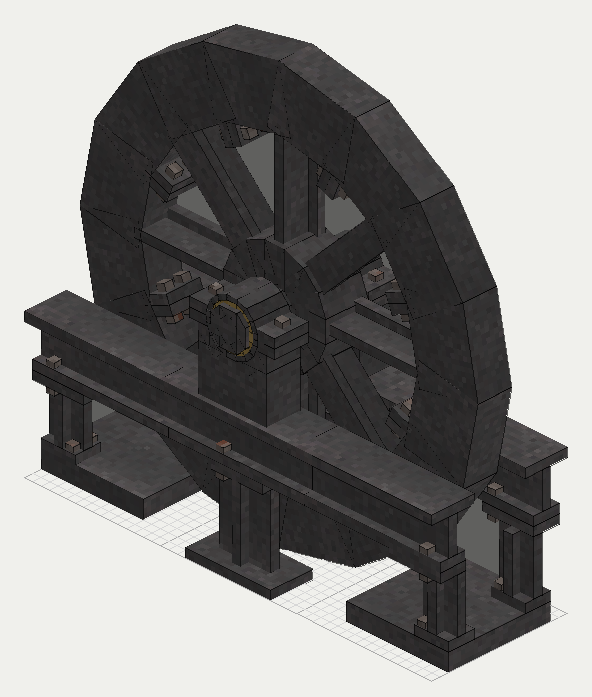
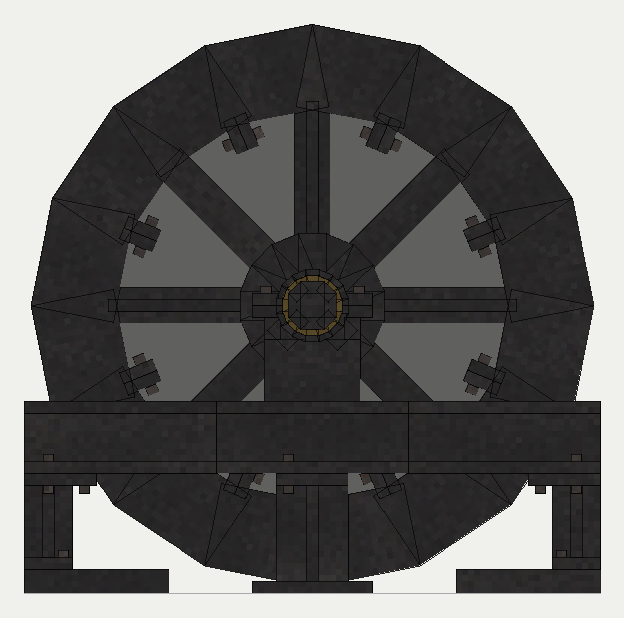 front
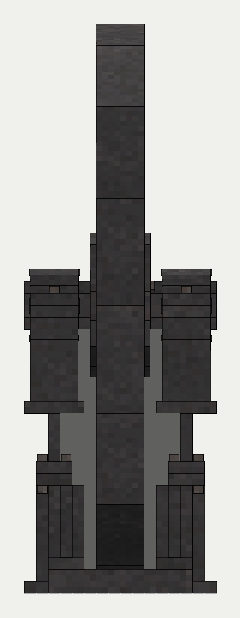 right
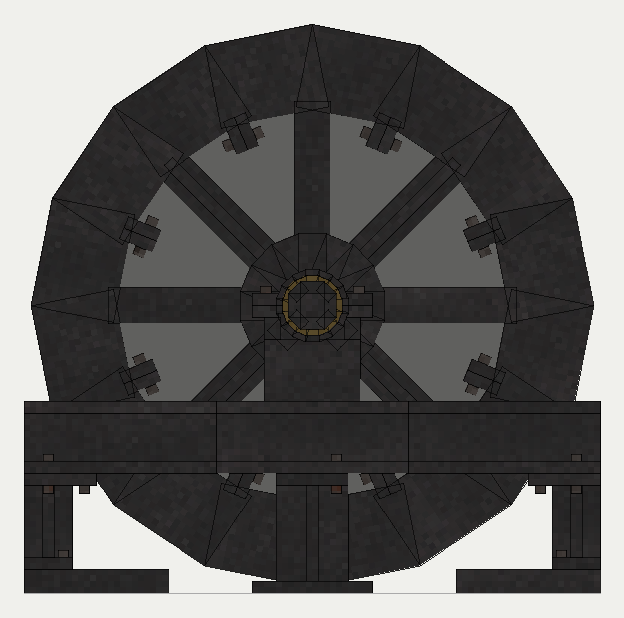 back
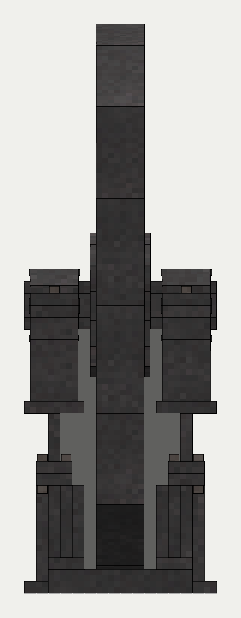 left
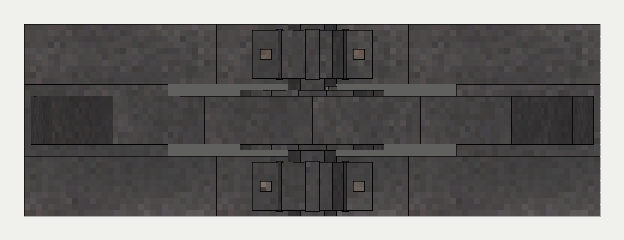 top
Made by
| Flywheel Standard Casting x 2 | Heavy Cast Plate x 2 | Bolts and Nuts |
| Flywheel | ||
Needs: 2 Flywheel Standard Casting, 2 Heavy Cast Plate, 1 Bolts and Nuts; makes 1 Flywheel
Amounts are the mod's defaults; the recipe-cost level changes them (see recipe cost levels).
Built in place
| Stage | Materials |
|---|---|
| 1 | none |
| 2 | Cast Iron Shaft, Flywheel Boss Casting, Brass Bush x 2, Lump of rendered fat, Bolts and Nuts |
| 3 | Flywheel Spoke Casting x 4 |
| 4 | Flywheel Spoke Casting x 4, Bolts and Nuts |
Needs: 1 Cast Iron Shaft, 1 Flywheel Boss Casting, 2 Brass Bush, 1 Lump of rendered fat, 2 Bolts and Nuts, 8 Flywheel Spoke Casting
Amounts are the mod's defaults; the recipe-cost level changes them (see recipe cost levels).
Crafting chain
The normal wheel is cast in three pieces, each from its own pattern, which is made from the flywheel diagram.
- Pig iron and coke or charcoal go into the Cupola Furnace and come out as molten cast iron.
- The molten iron is poured with the flywheel standard pattern in the Long Flask, which gives the Flywheel Standard Casting, a casting with its bearing cap beside it, and with the heavy plate pattern in the Small Flask, which gives Heavy Cast Plates.
- The flywheel boss and the flywheel spoke are poured in the Floor Flask or the Long Flask, which gives the Flywheel Boss Casting and the Flywheel Spoke Casting.
- The flywheel diagram, drafted at the Drawing Table, takes two Flywheel Standard Castings, two Heavy Cast Plates and a bolt bundle, which gives the frame.
Recipe
| Step | Where | Takes |
|---|---|---|
| Frame | Vice Bench | Flywheel Diagram, 2 Flywheel Standard Castings, 2 Heavy Cast Plates, 1 bolt bundle |
| Axle | Construction | Cast Iron Main Shaft, Flywheel Boss Casting, 2 brass bushes, rendered fat, 1 bolt bundle, wrench |
| First four spokes | Construction | 4 Flywheel Spoke Castings, wrench |
| Second four spokes | Construction | 4 Flywheel Spoke Castings, 1 bolt bundle, wrench |
The axle is a main-size shaft on the run: it couples to the shaft at either end, and the disc turns on the angle of the run it joins. The wheel adds its inertia to the run only when all four stages are done, and its rim bursts past 18.5 rad/s.
The large wheel
The large wheel is a structure of its own, two cells thick and fifty cells in all, on its own castings, each from its own pattern made from the large flywheel diagram.
- The Large Flywheel Pedestal, Bearer and End Frame Castings are poured in the Long Flask.
- The Large Flywheel Arm Casting is poured in the Floor Flask or the Long Flask, the Large Flywheel Rim Casting in the Long Flask, and the Large Flywheel Boss Casting in the Pit Flask.
- The large flywheel diagram takes two pedestals, four bearers, two end frames and a bolt bundle, which gives the frame.
| Step | Where | Takes |
|---|---|---|
| Frame | Vice Bench | Large Flywheel Diagram, 2 Pedestal Castings, 4 Bearer Castings, 2 End Frame Castings, 1 bolt bundle |
| End frames | Construction | none, the footing the frame places |
| Pedestals | Construction | none, wrench |
| Bearers | Construction | none, wrench |
| Axle | Construction | 2 Cast Iron Main Shafts, Boss Casting, 2 brass bushes, rendered fat, 1 bolt bundle, wrench |
| Arms | Construction | 8 Arm Castings, 1 bolt bundle, wrench |
| First four rims | Construction | 4 Rim Castings, 1 bolt bundle, wrench |
| Last four rims | Construction | 4 Rim Castings, 1 bolt bundle, wrench |
The two main shafts meet inside the boss, one at each hub cell, and the wheel is two nodes of the run: it couples to a shaft on either side. Its inertia, 150,000, is shared between the two nodes and counted once, only when all seven stages are done. Its rim bursts past 10.9 rad/s; when its rim bursts it leaves 64 bits of cast iron, and when a player breaks it, it leaves the materials paid so far.